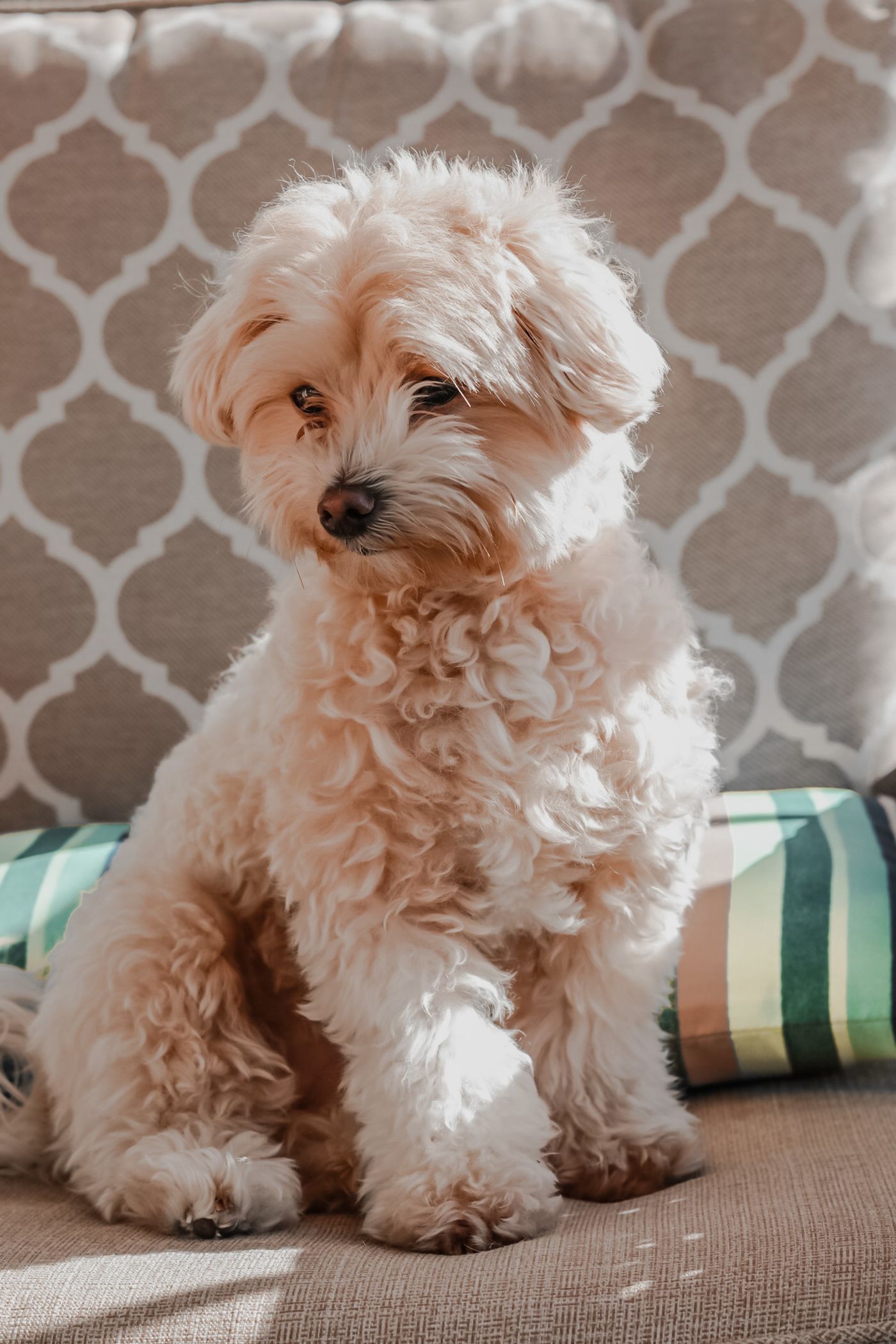
Maltipoo separation anxiety: can they be left alone?
Our care guide already flags this in passing. Here is the full, honest version: what separation anxiety actually looks like, how much alone time is realistic by age, how to build up to it, and when a Maltipoo is simply the wrong fit for your schedule.
Short answer: yes, a Maltipoo can be left alone, and yes, this breed is genuinely more prone to separation anxiety than most. Both things are true at once. Maltipoos were bred, on both the Maltese and Poodle side, to be close companion dogs, not working or independent breeds, and that shows up as real attachment to their people. With the right start, most Maltipoos learn to settle for a normal workday. Without it, this is one of the more common reasons a Maltipoo ends up with a chewed door frame or a re-homed listing.
What separation anxiety actually looks like
Separation anxiety is not the same as a puppy who whines for two minutes and then goes to sleep. Veterinary and behavior sources describe a consistent set of stress signs that show up specifically when a dog is left alone, and usually start within minutes of the door closing:
During your absence
Barking or howling that does not stop, destructive chewing or scratching concentrated at doors and windows (an escape attempt, not random mischief), house soiling despite being otherwise trained, pacing, and excessive drooling or panting.
Around departures and returns
Following you room to room as you get ready to leave, trembling or drooling as soon as you pick up your keys, and an unusually frantic, prolonged greeting when you come home. These pre-departure and reunion signs are often the earliest tell, before the destructive behavior starts.
One bad afternoon is not a diagnosis. What separates ordinary boredom from anxiety is the pattern: the same distress behaviors, tied specifically to being left alone, showing up again and again.
Why a Maltipoo, specifically, runs this risk
Veterinary behavior sources note that separation anxiety has no single confirmed cause, but several known triggers line up closely with how Maltipoos are typically raised and lived with: never being gradually taught to spend time alone, a sudden jump in the hours left alone after a schedule change, a change in household membership, or simply an especially strong bond with one person. A dog bred across two companion lines, small, people-oriented, often carried and cuddled from puppyhood, is exactly the profile behavior sources point to as more susceptible, not because the breed is fragile, but because it was never selected for independence in the first place.
This is not a flaw unique to this site's own puppies, and it is not something a breeder's health testing has any bearing on. It is a temperament trait built into the cross, which is exactly why our own care guide flags it as something to plan for rather than something to be surprised by.
How much alone time is realistic, by age
There is no single number that fits every dog, but the general shape trainers and vets use is consistent: young puppies need far more frequent breaks than adults, both for their bladder and for the training itself.
Under 3 months: roughly an hour alone at a time, sometimes stretched a little further, is the common starting point.
3 to 6 months: most puppies can work up to 2 to 3 hours as training progresses, not as a fixed rule but a general ceiling.
Adult, once trained: most guidance caps it around 6 to 8 hours, with a bathroom and social break well before that if you can manage it.
These are starting points, not guarantees. A dog already showing anxiety signs needs a shorter ceiling than this, worked back up gradually, not the maximum on day one.
Building tolerance: crate training and departure practice
The most consistently recommended approach is not a single trick but a slow, boring process, and it works better the earlier you start it. A crate helps only if the dog already sees it as a good place to be, not a punishment. Build that association first: feed meals in it, hide treats and a puzzle toy inside it, and let your puppy wander in and out with the door open before you ever close it for a real departure.
Once the crate itself is a non-issue, practice the departure separately from the crate. Pick up your keys, put on your coat, touch the door, and then sit back down, over and over, until those cues stop predicting that you are actually leaving. Then start leaving for genuinely short stretches, a few minutes at first, long enough that your dog barely notices, and only extend the time once each length is boring rather than stressful. Keep hellos and goodbyes low-key. A big, emotional departure or a big, emotional reunion teaches a dog that your leaving is a big event worth being anxious about.
A tired dog also copes better. A walk or a solid play session before you leave, paired with a food puzzle to occupy the first restless minutes alone, takes the edge off for a lot of dogs even before any formal training kicks in.
The honest complication: when a Maltipoo is the wrong fit
Here is the part a breeder's sales pitch usually skips. If nobody is home for most of the day, most days, a Maltipoo is a genuinely difficult match, not because training will not help, but because the breed was bred for closeness in the first place. Veterinary sources on this specific breed are direct about it: Maltipoos do best in homes where someone is around most of the day, and if the realistic answer to "can someone be with the puppy most of the day" is no, that is worth confronting before you bring one home, not after the chewed baseboards. A dog walker, a midday visit from a neighbor, or a doggy daycare day can close some of that gap. It does not fully replace a household where somebody is actually there.
This is not a reason to feel bad about wanting a Maltipoo. It is a reason to be honest about your actual schedule, the same way our choosing-a-puppy checklist asks you to be honest about health testing and paperwork before you fall for a photo.
When to get help instead of handling it alone
Talk to your vet first if anxious behavior appears suddenly or out of nowhere, since pain, illness, and even a urinary tract infection can produce symptoms, like house soiling, that look identical to anxiety on the surface. Your vet can rule out a medical cause before you assume it is purely behavioral.
If the behavior is already severe, self-injury from trying to escape, destroyed door frames, or no improvement after a few weeks of genuinely consistent short-departure practice, ask your vet for a referral to a certified trainer or a veterinary behaviorist rather than continuing to guess. For more serious cases, vets sometimes prescribe anti-anxiety medication alongside training. Fluoxetine and clomipramine are the two medications specifically FDA-approved for canine separation anxiety, used together with a behavior plan, not as a substitute for one. Whether medication makes sense for your dog is a conversation for your vet, not something to decide from an article.
Questions people ask about this
Can Maltipoos be left alone at all?
Yes, most Maltipoos can learn to handle a normal workday alone once they are gradually trained for it. What they do not do well with is being left alone from puppyhood with no adjustment period, or being left alone for most of every day, every week, with no break.
Does crate training cure separation anxiety?
No. A crate is a management tool, not a cure. Introduced early and built up slowly, with treats and short practice departures, it can help prevent anxiety from developing. Forcing an already-anxious dog into a crate and leaving fast can make the panic worse, not better.
How many hours a day is too many to leave a Maltipoo alone?
There is no single number that fits every dog, but most veterinary guidance caps a trained adult dog at around 6 to 8 hours between bathroom and social breaks. A young puppy needs far less, often just an hour or two at a time. A Maltipoo left alone for 10 or more hours on a regular basis is a real risk factor for this breed specifically.
What are the first signs of separation anxiety in a Maltipoo puppy?
Watch for whining, pacing, or barking that starts as soon as you leave, chewing or scratching concentrated at doors and windows, house soiling despite otherwise being trained, and an unusually frantic greeting when you return. One rough day is not a diagnosis. A pattern across several departures is worth addressing.
When should I call a vet or a trainer instead of handling it myself?
Call a vet first if the behavior is new or sudden, since pain and illness can look like anxiety. If a puppy is already destroying doors, injuring itself trying to escape, or not improving after a few weeks of consistent short-departure practice, ask your vet for a referral to a certified trainer or veterinary behaviorist rather than continuing to guess.
Ready for the parts of Maltipoo ownership that matter most?
Every puppy on this site comes from health-tested parents. Read the honest version of what day-to-day life and alone time actually look like before you say yes.